



Strengthening postoperative refraction and follow-up to improve effective cataract surgical coverage
Related content
It is essential to strengthen follow-up care and postoperative refraction services to ensure patients receive the full benefits of cataract surgery.
Uncorrected refractive error after cataract surgery is a major cause of avoidable visual impairment worldwide. Even when the operation is technically successful, patients may not achieve targeted visual outcomes without appropriate follow-up and refraction. Strengthening follow-up care and refraction is therefore essential to ensure patients receive the full benefits of cataract surgery, as uncorrected refractive error after the operation has a significant negative impact on visual outcomes. For example, a hospital-based study of 84,000 cataract patients found that postoperative refraction would improve visual acuity by two lines or more in 54.4% of all operated eyes: in 71.2% of eyes operated on using the manual small-incision cataract surgery (MSICS) technique and in 21.0% of eyes undergoing phacoemulsification.1
Postoperative refractive management also contributes to achieving the global target of improved effective cataract surgical coverage (eCSC) and improved vision-related quality of life.2
Current challenges in postoperative follow-up
Postoperative follow-up rates vary significantly across low- and middle-income countries. In a study involving 40 centres across ten countries in Asia, Africa, and Latin America – where patients were instructed to return for follow-up 40 days after the operation – the unprompted follow-up rates ranged from 27% to 93%, with an average rate of 51%.3 Another recent study investigating reasons for missed follow-up visits revealed multiple patient-reported barriers: ‘forgot’ (20%), ‘busy with my usual work’ (11%), ‘poor health’ (10%), ‘did not have information on follow-up’ (9%), ‘personal commitments’ (9%), ‘can see better with operated eye’ (8%), ‘no one to accompany me’ (8%), other (25%).4
In general, several key factors influence follow-up rates:
• Provider mindset. A common belief among eye care providers is that patients satisfied with their postoperative vision do not return for follow-up, so their vision must be good. As a result, the importance of follow-up is undervalued and not emphasised.
• Lack of structured communication. Often, it is not part of the protocol to counsel patients about the importance of coming back for follow-up visits; this can lead to poor compliance.
• Access challenges. Patients transported from outreach areas to a base hospital for cataract surgery are often expected to return on their own to the base hospital for follow-up, which they may find logistically or financially challenging.
• Multiple follow-up appointments. Patients are scheduled for several follow-up visits (day 1, week 1, week 2, month 1, month 2, and month 3), with refraction typically done only during the final visit. Most patients don’t show up after the first visit or two, and thus don’t get refraction done at the one-month follow-up visit.
Recommendations for postoperative follow-up and refraction
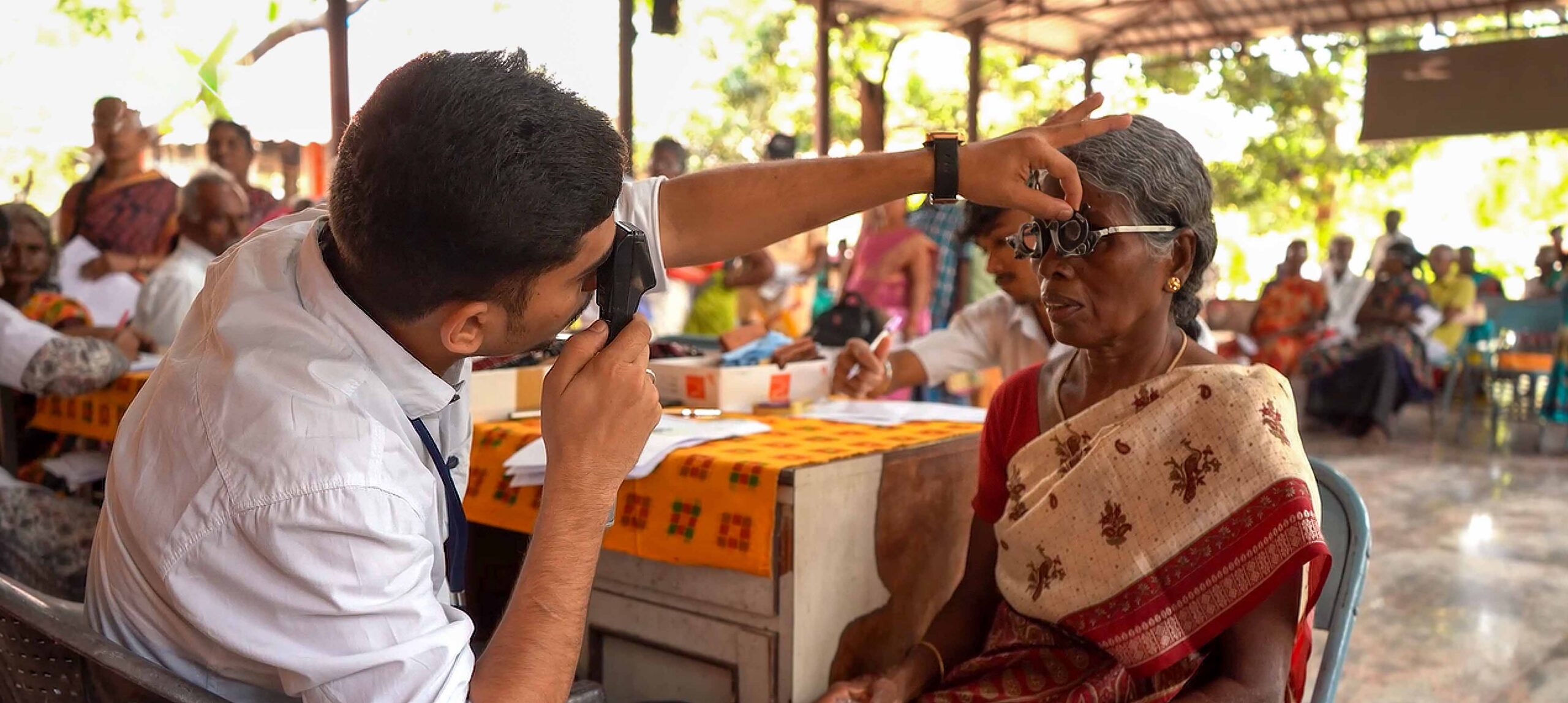
Refraction should be carried out once refractive stability is achieved. Ensuring that patients return for follow-up at this stage is essential, not only to prescribe appropriate spectacles but also to detect and manage complications early. For patients undergoing MSICS, postoperative refraction, as a routine, should be advised around 4–6 weeks after the operation, by which time the surgical wound would have healed and refractive stability is usually achieved. Exceptions to this could be those who had serious intraoperative complications or poor pinhole vision at discharge; a clinical decision can be made for these patients to come in earlier.
Due to a smaller incision and thus quicker healing, patients who undergo phacoemulsification may be assessed for refraction and prescribed spectacles as early as two weeks after surgery, provided no complications are detected during the postoperative visit.
During follow-up visits for postoperative refraction, we recommend the following:
• Assess near vision (to check for presbyopia) and carry out refraction if needed. Prescribe spectacles for near vision or direct patients to where they can purchase over-the-counter readers.
• Assess distance vision in all patients and check pinhole in all who cannot read 6/6 (20/20) in the operated eye.
• If vision improves with pinhole, carry out refraction and prescribe spectacles to correct distance refractive errors.
• If vision does not improve with pinhole or refraction for distance or near vision, patients should undergo a dilated examination to rule out other potential causes for reduced best-corrected visual acuity, such as cystoid macular oedema or other posterior segment pathologies, so they can be managed appropriately.
• For patients who are advised to return for follow-up to manage complications identified during the current visit, refraction should be performed at the subsequent visit to ensure that corrective spectacles are provided when appropriate.
Strategies to improve postoperative follow-up and refraction
• Changing the mindset of eye care providers. Eye care teams must recognise that postoperative follow-up is an integral part of the cataract surgery protocol. In addition to the opportunity to correct residual refractive error, it also offers clinical insights for continuous improvement.
• Counselling. Counsel patients and their family members – both when they report for surgery and at discharge – about the importance of coming back for final follow-up visits so they can enjoy the full benefits of cataract surgery.
• On-site follow-up for outreach patients. For patients identified and treated through outreach screening camps, the follow-up date and location (ideally the same site as the screening) should be pre-decided and clearly communicated both before the operation and at discharge. Community partners can help with the mobilisation of patients for follow-up on the scheduled date. Delivering spectacles on site can improve the effectiveness of refraction services.
• Using primary eye care centres for follow-up. In recent years, many eye hospitals have established primary eye care or vision centres. For patients living near a vision centre, the follow-up visit could be scheduled in such a centre, thereby reducing travel barriers.
• Integrating follow-up into cataract surgery services. Follow-up visits should be packaged as an integral part of cataract care and offered without additional cost. Similarly, the price of the operation could cover the cost of spectacles, or they could be given at a subsidised cost.
• ICT-enabled follow-up tracking. Using information and communication technologies (ICT) for prompts such as phone calls, SMS reminders, or WhatsApp messages is an effective way to remind patients about their scheduled follow-up visits. These tools help improve follow-up adherence by alerting patients in a timely and personalised manner.
• Data and monitoring. Hospitals should regularly monitor the follow-up rate to gain insights into how to improve it.
In certain contexts, where returning for follow-up is logistically difficult or very expensive, the status of the eye could be checked via a telephone call, and the patient’s distance visual acuity could be assessed and reported by a family member by using mobile apps like WHOeyes, the visual acuity assessment tool released by WHO (see bit.ly/3ZWYC6g). Patients should also be encouraged to visit a local eye care provider for near vision correction, if needed.
Team coordination and outcome monitoring to identify gaps
The outcome of a patient’s postoperative refraction visit reflects the collective efforts of everyone involved in that patient’s care journey, including the ophthalmologist, counsellor, biometry technician, supply-chain person, operating room team, and refractionist/optometrist. Outcomes can be continually improved through coordinated teamwork, regular review meetings, and completion of action items.
Reviews provide valuable feedback to optometrists and allied ophthalmic personnel about the accuracy and quality of biometry performed for intraocular lens (IOL) power calculation, while ophthalmologists gain insights into surgically induced astigmatism and overall postoperative outcomes. Additionally, follow-up visits may reveal intraoperative or postoperative complications that were initially missed. This feedback enables both optometrists and ophthalmologists to refine their skills and clinical decisions, ultimately leading to better patient outcomes.
Outcome monitoring should be treated as a multidisciplinary responsibility. Regular team reviews, shared learning, and a culture of continuous improvement can help identify and address gaps across the surgical care pathway. Examples include the following:
High spherical error When patients present with significant residual spherical error, it should be recognised as a potential biometry or implant error. A root cause analysis should be jointly conducted by the optometrist and ophthalmologist to identify possible reasons, such as incorrect machine calibration, poor measurement technique, transcription errors, or incorrect IOL power calculation or implantation.
High astigmatism Patients with unexpected high postoperative astigmatism should be reviewed by both the optometrist and ophthalmologist. The team should analyse the source of the error and explore preventive strategies, such as counselling patients on the option of toric IOLs, planning limbal relaxing incisions, or choosing the incision site for MSICS based on preoperative astigmatism.
Refractive surprises Spherical equivalent (SE) is calculated using the following formula:
SE = spherical power + cylindrical power / 2
As a guide, if the postoperative spherical equivalent at 30 days is greater than ± 1.0 D from the target refractive outcome in phacoemulsification, or greater than ± 2.0 D from target refractive outcome in MSICS, an examination should be performed to investigate the cause of the refractive surprise.
Rwanda
Theophile Thuyisabe, Kabgayi, Eye Unit, Rwanda
At Kabgayi Eye Unit in Rwanda, we identified a troubling pattern: numerous patients, particularly after cataract surgery, failed to return for follow-up appointments. Conversations with them revealed a significant concern. Although the initial operation was financed through insurance or other programmes, they were told that the community insurance did not cover the cost of the spectacles. Therefore, they were genuinely anxious about potential hidden costs related to follow-up care, such as acquiring new spectacles or scheduling extra check-ups. It was heartbreaking to discover that some patients opted not to come back, enduring blurry vision because they felt they had exhausted their financial resources.

We knew we had to do something to ease their minds, so we introduced a support system specifically for follow-up care. This meant assisting vulnerable patients with their transportation costs and providing spectacles free or at an affordable price to those in need. We ensured that every patient was informed about these changes before they left, both through direct conversation and clear written communication. Our message was straightforward: your return visit is crucial for your vision, and it won’t come with any surprise bills. Our clinical team even followed up with phone calls and texts to remind them and provide reassurance.
The impact was immediate and heartwarming: we saw a significant increase in follow-up visits, and more patients were getting the refractions and spectacles they needed. Their smiles told us they were happier, and they started telling their friends and neighbours about our commitment to their well-being. Crucially, this allowed us to fine-tune their vision even further, leading to much better surgical outcomes and, ultimately, to more people coming for cataract surgery, thereby improving our surgical outcome indicators, including eCSC.
India
Pankaj Vishwakarma, Mission for Vision, India
Tulsi Eye Hospital, founded in 2002 in Nashik in the state of Maharashtra, is a charitable organisation focused on providing eye care to underserved communities. Through its extensive rural outreach programme, the hospital carries out approximately 16,600 cataract surgeries each year, of which 57% are provided at no cost to patients from socioeconomically weaker communities. A committed outreach team ensures that patient care continues well beyond the operation. Each cataract patient is scheduled for two post-surgery follow-up visits. During the final follow-up, refraction is conducted and bi-focal spectacles are distributed at no cost.
At the time of discharge, patients are educated on the need for follow-up visits, which are conducted at the same locations where the initial camps were held. Follow-up compliance is further encouraged through reminder phone calls. Even so, attendance rates remain between 70% and 75%, with patients often citing reasons such as lack of an accompanying companion, financial constraints, limited transportation options, or satisfaction with their vision for not returning.
To complete the follow-up process, patients typically need to attend camp again to collect their spectacles. The hospital has also developed a network of village volunteers who support the outreach team. These volunteers play a key role in connecting with patients, ensuring that eye care continues beyond surgery through consistent follow-up and strong community involvement.
Conclusion
Follow-up care and postoperative refraction significantly contribute to enhancing patients’ visual functioning, as well as eCSC, and thus they must be seen as essential parts of cataract services. Cataract programmes should make follow-up easy, provide clear communication, and use technology and community networks to enable patients to return for follow-up. These simple and practical steps can make a significant difference to patient outcomes and help to further reduce avoidable vision impairment due to uncorrected refractive error.
References
1 Gupta S, Ravindran RD, Subburaman GB, S AV, Ravilla T. Predictors of patient compliance with follow-up visits after cataract surgery. J Cataract Refract Surg. 2019;45(8):1105-1112. doi:10.1016/j.jcrs.2019.02.024
2 Vishwakarma P, Sundararaj L, Chavan S, et al. Spectacle compliance postcataract surgery significantly improved vision function-related quality of life of adult patients in India: Evidence from a multicenter longitudinal cohort study. Oman J Ophthalmol. 2023;16(3):500-508. doi:10.4103/ojo.ojo_234_22
3 Congdon N, Yan X, Lansingh V, et al. Assessment of cataract surgical outcomes in settings where follow-up is poor: PRECOG, a multicentre observational study. Lancet Glob Health. 2013;1(1):e37-45. doi:10.1016/S2214-109X(13)70003-2
4 Vishwakarma P, Mondal A, Ranpise D, Sundararaj L, Shaikh S, Chavan S, Kurian E. Barriers to attending one-month review post cataract surgery by patients availing free cataract treatment in India. Int J Community Med Public Health. 2025;12(6):2538-45. doi:10.18203/2394-6040.ijcmph20251690