



Training frontline community health workers for presbyopia services: lessons from a pilot in rural India
Related content
Frontline health workers in rural India were trained to screen for presbyopia and dispense ready-made spectacles. This pilot demonstrates how community-based approaches can expand access to vision correction in low-resource settings.
A pilot in Jhajjar district, Haryana, India showed that trained Accredited Social Health Activists (ASHAs) can effectively screen near vision and dispense ready-made near-vision spectacles. ASHAs are female community health workers under India’s National Health Mission who provide basic health services at the community level.
The pilot was designed to address gaps in access to presbyopia services in rural communities, where distance, cost, and limited awareness can prevent people from obtaining near-vision correction.
Training ASHAs to provide presbyopia services
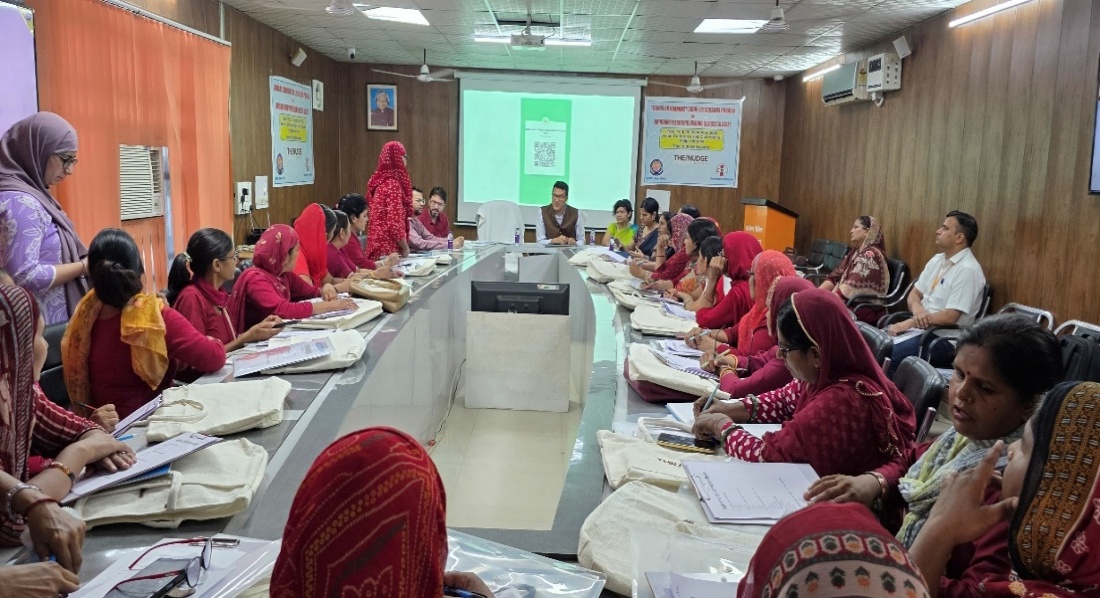
ASHAs attended a structured two-day training programme led by a community ophthalmologist, an optometrist, and field staff. Training combined short classroom sessions with practical demonstrations and supervised hands-on practice. Following training, ASHAs were able to screen near vision, dispense ready-made near-vision spectacles to people with good distance vision (≥6/12 with or without spectacles) who had reduced near vision, and refer people requiring further assessment.
A simplified Presbyopic Services E-chart (PSE Chart) was used during screening. The chart assessed distance and near vision at three meter and near vision at 40 cm. The chart included one 6/60, three 6/24, and five 6/12 optotypes for distance vision, and N12–N16 optotypes for near vision. Near-add powers were determined using an age–power approximation (APA) table, based on published evidence about the age-related changes in near-vision requirements.1,2
Training outcomes
An evaluation involving 56 participants showed that trained ASHAs could accurately identify people who needed near-vision spectacles. The approach achieved 90% sensitivity and 100% specificity. There were no false positives. The positive predictive value was 100%, and the negative predictive value was 94.7%. These findings suggest that community health workers can safely provide basic presbyopia services when supported by appropriate training, tools, and referral pathways.
Factors contributing to success
Several features contributed to the success of the model. The simplified PSE chart made vision screening easier, while the APA table reduced the need for the multiple lens trials. Practical, hands-on training improved confidence and consistency among ASHAs. Clear referral criteria were also important. People with reduced distance vision (<6/12 in the better eye), or those who could not achieve N6 vision with trial lenses, were referred to the nearest facility with an optometrist for further assessment. Together, these components created a simple service delivery model that could be adapted for use in other low-resource settings.
Implementation challenges and lessons learned
Several programme and system-level barriers were identified during implementation.

Initially, many ASHAs found standard vision charts difficult to use. Selecting the correct near-add power using multiple trial lenses was also time-consuming and reduced confidence among health workers. Introducing the simplified PSE chart and APA table made screening and dispensing quicker and easier. Structured training and supervised practice further improved confidence. Operational challenges included maintaining a reliable supply of ready-made spectacles and ensuring accurate record keeping. These issues were addressed through regular distribution of spectacles during review meetings and the introduction of simple monitoring tools.
At the health-system level, presbyopia services were not routinely integrated into existing supply chains or monitoring systems. Delays in incentive payments and competing responsibilities for ASHAs also affected implementation. However, strong community trust in ASHAs supported uptake and helped maintain participation.
This pilot showed that ASHAs can safely provide basic presbyopia services when supported by simple tools, practical training, and clear referral pathways.
References
1 Han X, Lee PY, Liu C, He M. Distribution and progression of add power among people in need of near correction. Clin Exp Ophthalmol. 2018;46(8):882–887. doi:10.1111/ceo.13301
2 Yekta A, Hashemi H, Ostadimoghaddam H, Jafarzadehpur E, Salehabadi S, Sardari S, et al. Amplitude of accommodation and add power in an adult population of Tehran, Iran. Iran J Ophthalmol. 2013;25(3):182–189.