



Advancing ophthalmic training: the role of subspecialty fellowships
Related content
Fellowships can have lasting benefits for ophthalmologists and their home institutions.
International subspecialty fellowships allow ophthalmologists to spend time at a host institution in another country. It is not only an opportunity to gain knowledge and skills in your own subspecialty; the chance to work in another institution also exposes fellows to the challenges and opportunities of different health systems, and to population groups, disease profiles, and presentations they may not have encountered before.
Spending time away from family and your place of work can be challenging, for fellows and those left behind. If you are considering applying for a fellowship, speak with family members, colleagues, and the hospital administration about your reasons for doing so. Explaining how the fellowship will benefit your department and improve patient outcomes will help to make colleagues and managers more receptive to new ideas on your return. In a 2020 study, 92% of ophthalmologists who had taken up a fellowship said they learnt techniques in diagnosis, treatment, or surgery that were new to them, and 85% began regular teaching events in their department after their return.1
Finding a fellowship
Over the last 5 years, 420 ophthalmologists from underserved and low-resource countries have received support from the IOFF–OF programme to undertake advanced subspecialty training or research opportunities at leading international eye centres. The fellowships are administered by the International Ophthalmological Fellowships Foundation (IOFF) in collaboration with the Ophthalmology Foundation (OF). Most of the fellowships are three-month ‘observerships’ that support candidates to observe outpatient clinics and surgical procedures at host institutions in 30 countries. A limited number of surgical fellowships are offered at host institutions in India and China; these require candidates to apply for a temporary licence to practise. Generous financial support is available to cover travel and living expenses, making the opportunity accessible to candidates worldwide.
Essential criteria for IOFF-OF fellowships:
• From, and permanently based in, a low-resource or underserved country
• Completed residency training and obtained a Specialist in Ophthalmology degree, which means candidates can practise independently
• Less than 40 years of age
• Strong recommendations from candidates’ head of department and residency director.
There are close to 100 fellowships available per year, with 2–3 applicants competing for every space. Applications are assessed against a structured scoring framework, and additional weight is given to applicants from settings with the greatest public health need.
Personal experience
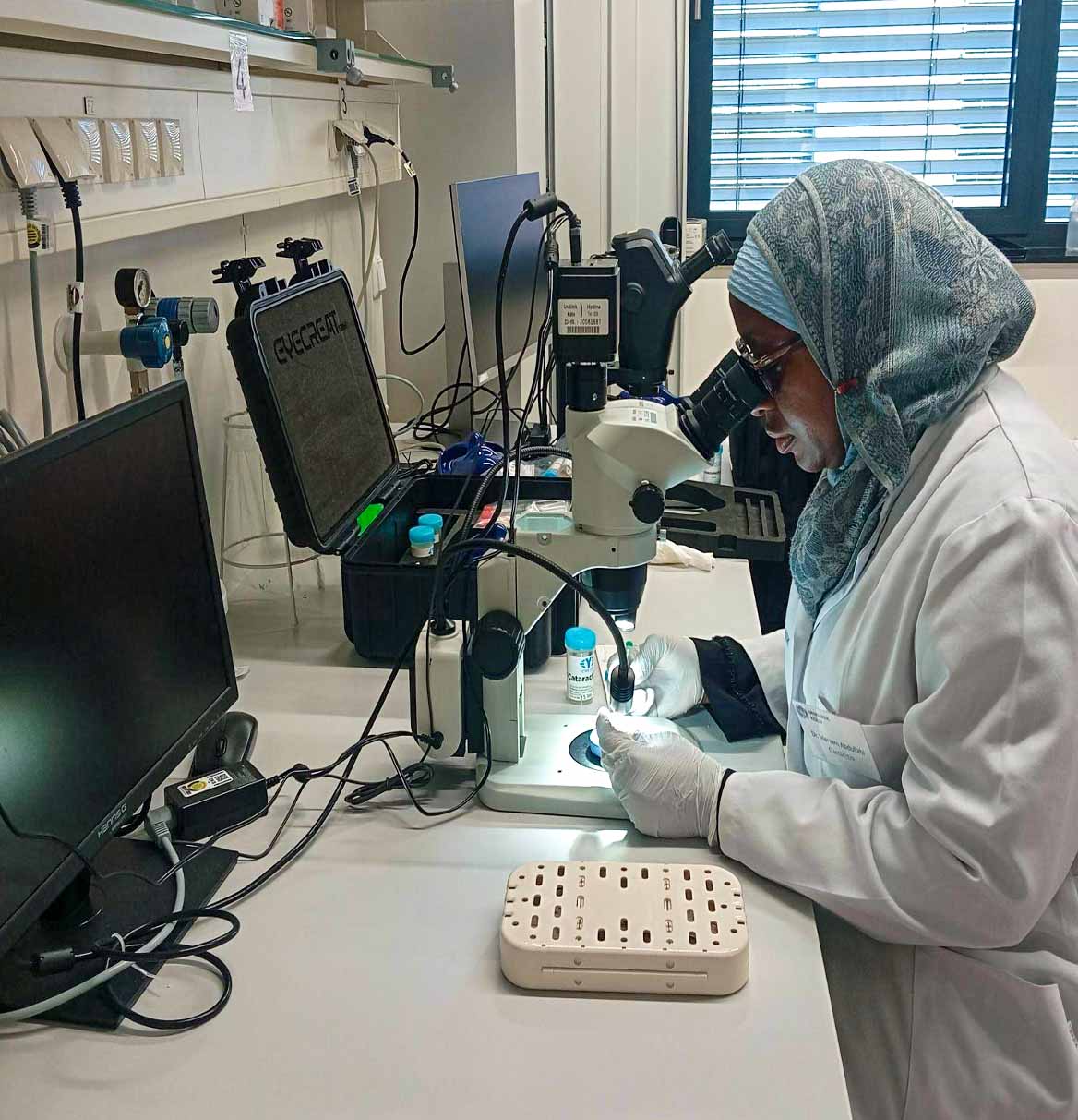
Dr Maryam Idris Abdullahi (Nigeria) undertook a 3-month observership in Germany in 2024. “I learnt the pearls of glaucoma management, from patient assessment to all currently available glaucoma treatment modalities. I also had in-depth exposure to SLT laser, trabeculectomy, glaucoma drainage devices, and MIGS. I was also privileged to use simulation eyes to practise trabeculectomy. During my training, I attended two international conferences; the knowledge gained and the opportunity to network with teachers and colleagues was very much appreciated. I am currently collaborating with my German fellowship supervisor and her research team in glaucoma research.”
New essential criteria Completion of the OF international ophthalmology examinations – which provide an internationally benchmarked standard – will be mandatory for all applicants from September 2027. This ensures that valuable fellowship time is not wasted assessing how much the ophthalmologist already knows, or in covering basic knowledge before focusing on the area of need identified in the application. Under the new requirement, applicants must either:
• Pass the OF Visual Sciences and OF Optics, Refraction & Instruments examinations, or
• Hold approved exemptions from those examinations and pass the OF Clinical Ophthalmology examination.
Until July 2027, OF examination passes remain optional but continue to strengthen fellowship applications through additional credits. From 2027, the new fellowships application deadline will be 31 August 2027, to align with the OF examinations timeline.
For more information about the exam criteria, visit bit.ly/Pd5bh7. To apply, visit bit.ly/7gbq3q.
References
1 Torres-Netto EA, Gabel-Obermaier C, Gabel P, et al. Twenty years of International Council of Ophthalmology fellowships: description of the programme and the impact on more than 1100 awardees. Br J Ophthalmol. 2021;105(9):1318-1324. doi:10.1136/bjophthalmol-2020-316484
The content of this page is supported by the Ophthalmology Foundation